- Persuade & Raise
- Posts
- ♞ Understanding valuations

One of the most painful conversations in the startup ecosystem happens when a founder tries to sell a struggling business.
Many mistakenly think that the valuation they received during funding rounds represents the business's value. The reality is that when raising venture capital, investors don’t value the company based on its current assets; they value it based on its potential. They are buying a lottery ticket and deciding how much to pay for it.
A few years later, if your company has stagnated and you are being acquired, that potential is gone, so the valuation is based on current assets, that can be a shock to many founders.
Today, we are breaking down why early-stage pricing is an illusion—and how confusing a venture bet with actual market value can be when it’s time to exit.

Traditional client acquisition loops waste your scarcest asset: time. On June eleventh, Taylor Conroy reveals how to shift from one-to-one selling to one-to-many authority building. Learn to land global stages, command higher pricing power, and turn your marketing department into an immediate profit center.
Save your free spot now.
The biggest mistake founders make is assuming that the formula used to price a fundraising round is the same formula used to price an acquisition. They are two completely different calculations—non-overlapping circles that operate on entirely different assumptions.
When an investor backs you at a $5M cap when you only have a pitch deck and a prayer, they aren't valuing your current business. They are looking at the landscape and saying, "If everything goes perfectly—the market explodes, the timing hits, the execution is flawless—this could be a multi-billion-dollar monster."
When your growth engine stalls, your valuation metric undergoes a violent structural shift. You move from the realm of Venture Multiples (which are based on imagination and hype) to Fundamental Multiples (which are based on cash flow and stability).
When you are growing 300% a year, the market will gladly give you a massive multiple because they are pricing tomorrow's dominance. When your growth drops to 10%, you are judged by the cold rules of traditional corporate finance. A buyer will look at your $1.5M ARR and price it at a standard asset multiple. The fact that an investor once wrote a check at a $5M cap is completely irrelevant to them.
Understanding this isn’t only valuable to founders who might be looking to sell, but it’s also a valuable perspective for those raising venture capital. It allows you to understand and explain your valuation in a way that makes sense to investors. Focusing more on the potential outcome and associated risks, and less on the assets.
Attio is the AI CRM for high-growth teams.
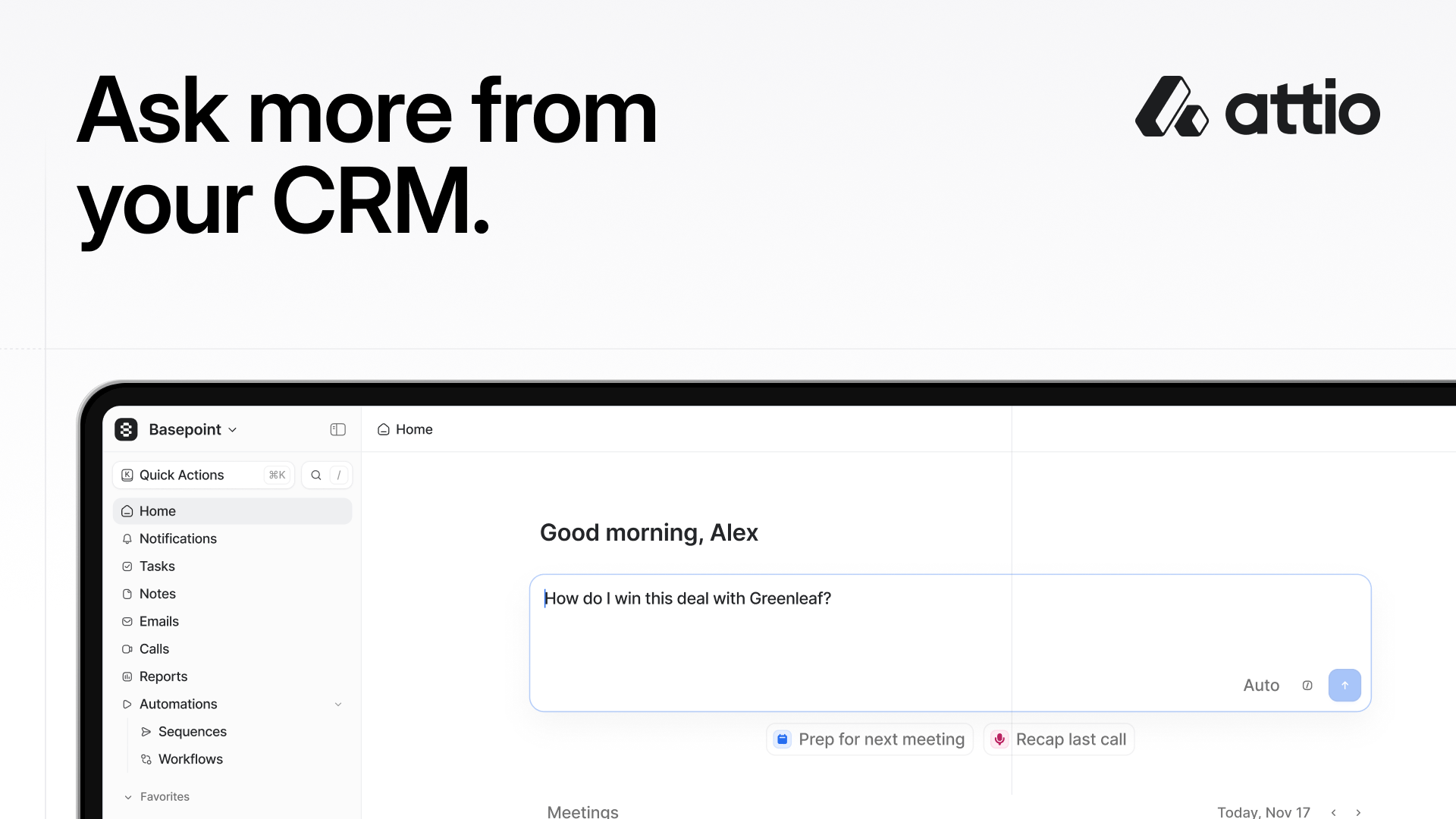
Connect your email, calls, product data and more, and Attio instantly builds your CRM with enriched data and complete context. Whether you’re running product-led growth or enterprise sales, Attio adapts to your unique GTM motion.
Then Ask Attio to plan your next move.
Run deep web research on prospects. Update your pipeline as you work. Find customers and draft outreach emails. Powered by Universal Context, Attio's intelligence layer, Attio searches, updates, and creates across your data to accelerate your workflow.
Ask more from your CRM.
Are you looking to grow your business? Here is how I can help:
📱 Book a Strategy Call to get 1:1 feedback on your pitch, pitch deck and/or fundraising strategy. (If you need general startup advice, then reply to this email, and I’ll let you know if/how I can help.)
Onwards and Upwards,

Sponsored By:
